5-axis CNC milling is suitable for large parts, complex curved surfaces, plugs, patterns, models and components that require accurate machining from multiple angles. It is especially useful when the geometry is difficult to produce with conventional 3-axis machining.
Large-Format 5-Axis CNC Milling
Composite Plus operates large-format 5-axis CNC milling machines for plugs, direct moulds and composite tooling where size, surface accuracy and further composite production all matter.
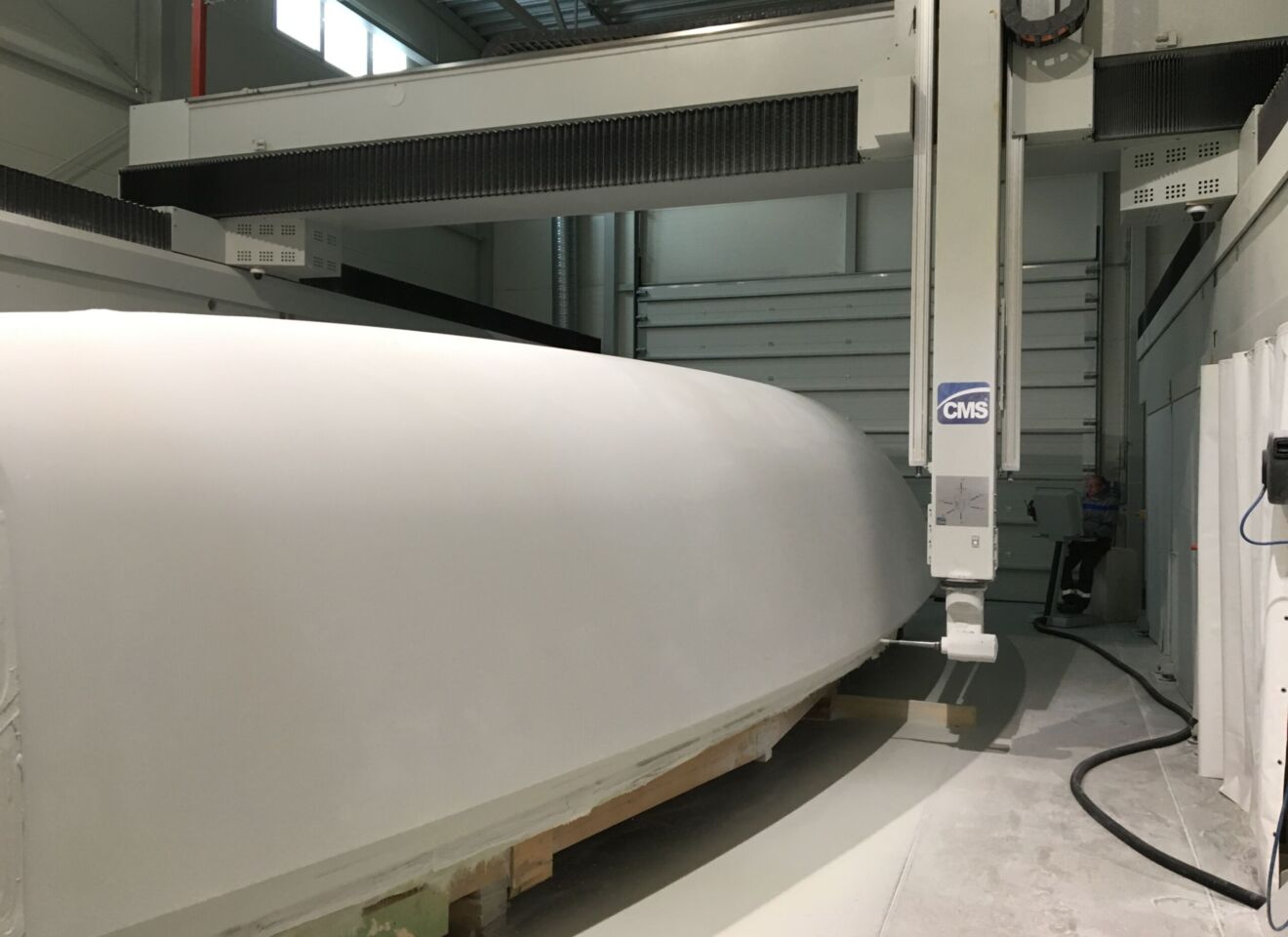
Large-format CNC milling for tooling projects
Composite Plus runs two 5-axis CNC milling machines capable of machining large and geometrically complex shapes from digital 3D data. The machines produce plugs and surfaces with a surface roughness down to 0.17-0.2, which is the level of accuracy required for production of composite tooling.
The service is suited to customers who need a CNC-milled plug, master model or direct mould as the starting point for composite production. We work from supplied 3D files in formats including STEP, IGES and PARASOLID, so the milled geometry follows the required shape and dimensions directly from the digital model.
What makes the setup at Composite Plus practical for composite projects is that the milling service is not isolated. It sits within the same production environment as plug finishing, mould making and GRP manufacturing. A customer bringing a 3D model for CNC milling can continue into the full tooling and production workflow without needing to coordinate separate suppliers for each stage. Full production process from CNC milling to final tooling is exactly traceable and controlled through the all stages.
What we mill
The exact approach depends on the size, geometry, material and intended use of the part. Typical projects include the following.
- CNC-milled plugs
Plugs milled from digital 3D data and used as the basis for taking production moulds. After milling, plugs are sanded and finished to the required surface quality before mould making begins. All plugs are built on a rigid plywood or steel frame, avoiding the possible deformations and secures perfect accuracy. - Direct moulds
In some cases the CNC-milled plugs becomes the mould itself rather than a plug for a separate mould. Direct mould production is suitable where geometry, production volumes and surface requirements make it a practical alternative to the full plug-and-mould workflow. Direct moulds are used for low production volume production. - Large-format model production
CNC milling for large models and shapes used in architectural, marine, industrial, transport and other technical composite projects where the scale of the part goes beyond what smaller machining equipment can handle.
We provide precision CNC milling services for companies across various industries, including architecture and the outdoor sector. We manufacture custom curved and shaped components, such as outdoor furniture, sculptures, and interior design elements. We offer our engineering services to take artistic concepts and bring them to reality.
We provide CNC milling services for prototypes, custom parts, and production runs, delivering precision-machined components that meet the highest quality standards.
Why 5-axis matters for large composite work
5-axis milling can produce many shapes, but it becomes a limiting factor on large, curved and geometrically complex composite tooling. With five axes of simultaneous movement, the cutting tool can follow compound curves, undercuts and angled surfaces in a single setup. This reduces the number of repositioning steps, which improves surface consistency and dimensional accuracy across a large part.
For composite tooling specifically, this matters because surface quality at the plug stage carries through to every mould taken from it, and from there into every GRP part produced from that mould. Errors introduced early in the tooling chain are difficult to correct later without rework that adds time and cost.
The practical benefits for projects at Composite Plus
- Large and complex shapes can be milled accurately in a single setup
- Surface roughness down to 0.17-0.2 mm
- Geometry follows the digital model directly, which removes manual interpretation errors
- Suitable for materials including styrofoam, model paste, MDF, wood and glass fibre based materials
Frequently asked questions
Composite Plus can machine large-format parts, plugs and models using in-house 5-axis CNC milling equipment. The suitable part size depends on the geometry, material, required accuracy and whether the model can be produced as one piece or in several sections. Basically there is no limits on final size, it is possible to connect several milled parts into one big plug.
We can machine large-format parts, plugs, and models using our in-house 5-axis CNC milling machines. The maximum part size depends on the geometry, material, required accuracy, and whether the model is manufactured as a single piece or in multiple sections. There is virtually no limit to the overall size, as several machined sections can be precisely joined to create one large component.
We usually need a 3D model or technical drawings with clear dimensional information. Useful details include the required size, tolerances, surface finish, material, intended use and whether the machined part will be used as a plug, pattern, model or finished component. Common file formats include STEP, IGES and PARASOLID.
Yes. 5-axis CNC milling is often used to produce plugs, patterns and models for composite mould making. Composite Plus can support the process from CNC machining to further plug preparation and GRP mould production where required.
Accuracy and surface finish depend on the material, geometry, milling strategy, tool selection and finishing requirements. CNC milling can create an accurate base geometry, while additional sanding, sealing, priming or polishing may be needed when the part is used for high-quality mould making.
Cost and lead time depend on the size and complexity of the part, material choice, CAD file quality, machining time, required surface finish, tolerances and any additional finishing or assembly work. Large parts, complex curved surfaces and high-finish requirements usually require more preparation and production time.
Need large-format CNC milling for a composite project?
Send us your 3D model, drawings or project brief and we’ll help evaluate the most practical milling and tooling approach.