A plug is a master model used to produce a mould. It is usually CNC-milled, finished and prepared to the required surface quality before mould making. A production mould is the tool used to manufacture repeatable composite parts. A direct mould is a CNC-machined plug/mould that can be used directly for part production when the geometry, surface requirements and production volume make this approach suitable.
Composite Plugs and Moulds
Composite Plus manufactures plugs, direct moulds and production moulds for composite tooling projects. With 5-axis CNC milling and GRP mould making handled in-house, the accuracy established at the plug stage carries through into the finished mould and the parts produced from it.
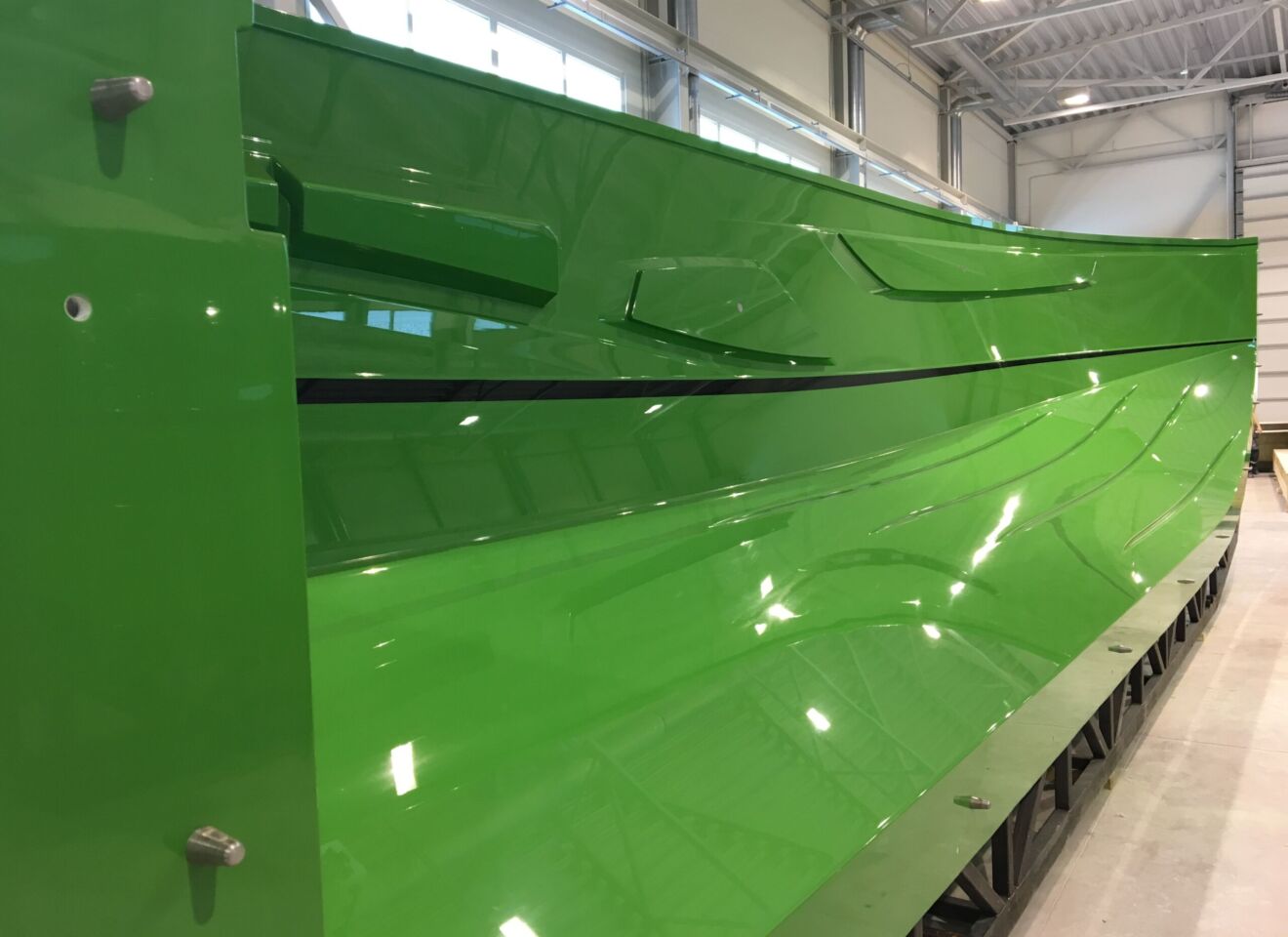
GRP Tooling is where composite production begins
The quality of a finished GRP part is largely determined before a single layer of glass fibre is laid. Surface finish, dimensional accuracy and repeatability in production all depend on the quality of the production mould. The quality of the mould depends on the quality of the plug it was taken from. Getting the tooling stage right is not a cost to be minimized early in a project. It is the investment that determines how efficiently the rest of the production runs.
Composite Plus handles the full tooling chain in-house: from CNC-milled plug through to finished production mould or direct mould. For customers who are developing a new composite product or scaling an existing one into repeatable production, this means the tooling workflow does not need to be split across multiple suppliers.
Plugs
The master shape from which every production mould is made. Accuracy at this stage carries through into every mould and every part that follows.
Composite Plus mills plugs on 5-axis CNC milling machines, working from supplied 3D data. After milling, plugs are sanded and finished to the required surface quality before mould making begins. All plugs are built on a rigid plywood or steel frame.
- Surface roughness: 0.17–0.2 mm
- Accepted file formats: STEP, IGES, PARASOLID
- Frame construction: Rigid plywood or steel
Production moulds
The tool used for repeatable GRP manufacturing. Mould quality determines surface finish, dimensional consistency and production lifespan.
Composite Plus manufactures GRP production moulds using tooling systems selected for the demands of the application. We work with rapid tooling systems (RTS) based on vinyl ester gel-coat and resins that offer heat and styrene resistance, high mechanical load capacity and long-term surface gloss. Mould frames are 3D-engineered and steel-reinforced, designed to the specific production setup and part size.
- Tooling system: Rapid tooling systems (RTS)
- Gel-coat and resin: Vinyl ester based, heat and styrene resistant
- Frame: 3D-engineered, steel reinforced
- Turning systems: Available on request
Direct moulds
In some projects, the CNC-milled plugs becomes the mould itself, removing the intermediate plug stage entirely.
This approach is suitable when project geometry, production volumes and surface requirements make it a practical alternative to the full plug-and-mould workflow. Direct moulds can reduce overall tooling lead time for certain projects. Suitability depends on the specific part and production requirements and is evaluated during the quotation stage. Direct moulds are used for low-volume production or prototyping issues.
How the three stages connect
For most new composite products, the typical sequence is: CNC-milled plug, then production mould made from that plug, then GRP production from the mould. Each stage depends on the quality of the one before it.
- 3D model: Supplied by customer in STEP, IGES or PARASOLID format.
- CNC-milled plug: 5-axis milling to tolerance, then sanding and finishing to required surface quality.
- Production mould: GRP mould taken from the finished plug, steel-reinforced frame engineered to production requirements.
- GRP production: Repeatable composite parts manufactured from the mould.
In some cases the sequence is shorter. A direct mould removes the intermediate plug stage. If the customer already has a suitable mould or an existing part that can serve as the starting point, the required tooling step may be different again.
For customers developing a new product, the full workflow from 3D model through CNC milling, plug preparation, mould making and GRP production can be handled without coordinating multiple suppliers.
Frequently asked questions
A CNC-milled plug is usually the better choice when the final mould needs a high-quality surface, long service life, repeatable production capability or additional mould reinforcement. A direct mould can be suitable for simpler geometries, prototypes, limited production runs or projects where the machined mould surface is sufficient for the intended part.
We usually need a 3D model, technical drawings or other clear dimensional information to evaluate the project. Useful details include the required part size, tolerances, surface finish, expected production volume, intended production method and how the final composite part will be used. Common CAD file formats include STEP, IGES and PARASOLID.
Yes. Composite Plus manufactures plugs and moulds for large composite parts and technical structures. Large tooling projects can be produced as single pieces or in sections, depending on the part size, geometry, transport requirements and mould handling needs. Reinforcement structures or support frames can also be added where required.
Yes, in most cases. CNC milling creates the base geometry, but the plug usually needs sanding and finishing before it is ready for mould making. The level of finishing depends on the required surface quality of the mould and the final GRP part.
Draft angles and undercuts affect how easily the finished part can be released from the mould. Complex shapes may require split moulds, additional flanges or a different moulding strategy. Surface finish is also important, because the quality of the plug and mould surface has a direct impact on the appearance and finish of the final composite part.
Lead time depends on the size and complexity of the part, the quality of the input files, CNC milling time, finishing requirements, mould type, reinforcement needs and whether the tooling must be produced in sections. Projects that require a split moulds, high-gloss surface, complex geometry or additional support frames usually take longer than simpler tooling projects.
Planning a plug, production mould or direct mould?
We can support your tooling project from 3D data and CNC-milled plugs through to finished GRP production moulds.